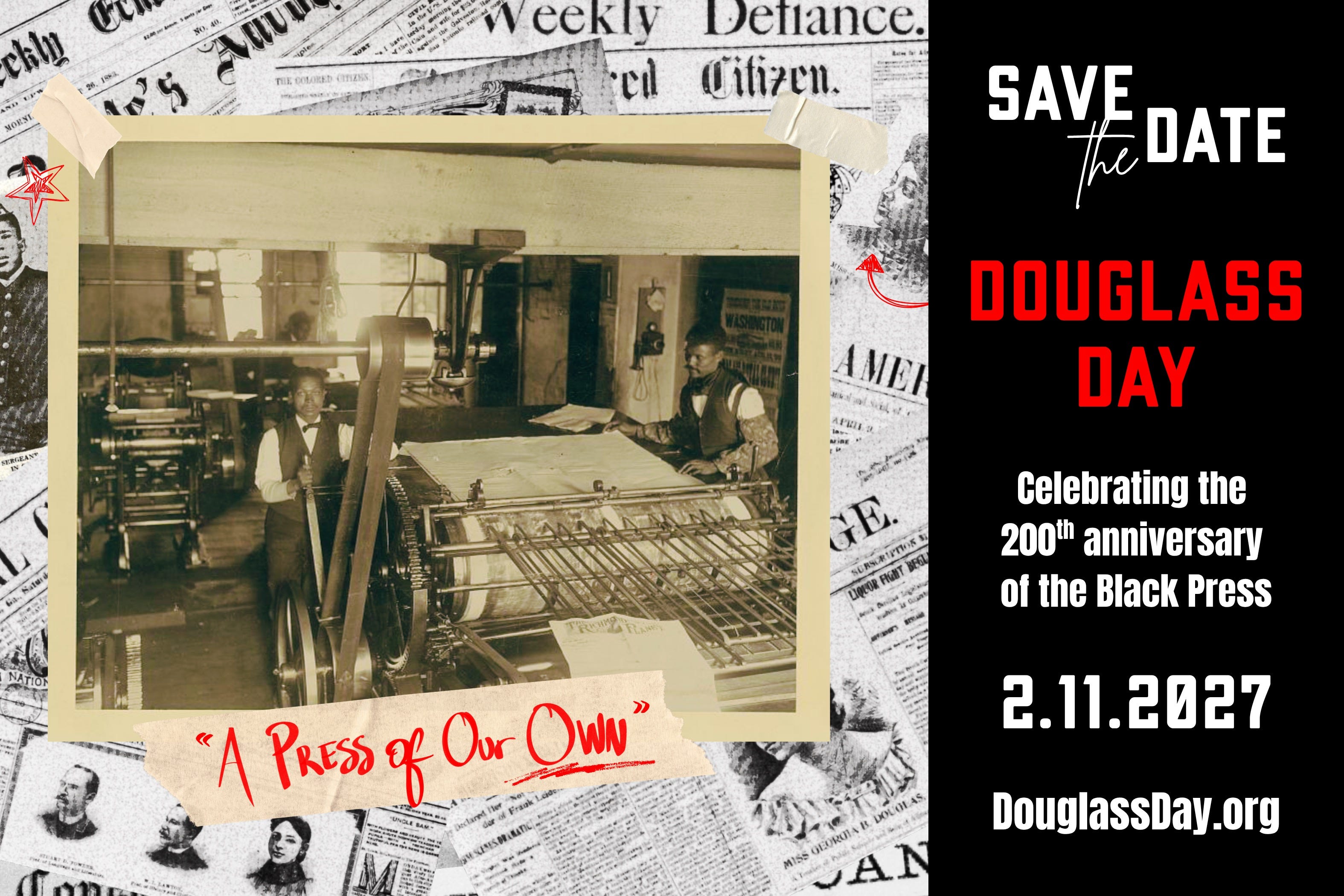
A Press of Our Own: A Short History of the Early Black Press
“We need a Press—a press of our own.”
Our theme this year is “A Press of Our Own.” These words come from a newspaper called the Weekly Anglo-African, edited by Thomas Hamilton in 1859. Hamilton – like so many before and since – saw the power of Black-owned media. In the face of lies told by the mainstream media, Black editors and journalists have spoken truth to power for centuries. In 2027 we can celebrate the long tradition of Black-owned media.
“A press of our own” has many meanings. So much depends on who gets to control what can be said in the media. Who owns the media? What can be ours? What becomes possible in community newspapers?
A lot becomes possible! A press can create spaces for people to share their stories and ideas. Early Black papers made space for people in their communities to reflect on freedom, faith, and family life. Thinkers and activists debated politics in their towns and around the world. Black businesses paid for advertisements to support local Black papers. Men, women, and children read these papers and shared them with friends & neighbors. They fashioned a press all of their own. They left a profound legacy.
A Very Brief History of the Black Press
Black people have been publishing newspapers and magazines for two centuries. The first Black newspaper was named Freedom’s Journal. It began in New York City in 1827. In 2027 we will mark 200 years of the Black press.
It is a vast and fascinating history. Hundreds of Black men and women worked as journalists, editors, printers, and publishers. Millions read these papers over time. What got produced in the print shops went into churches and schools and beyond. Many Black papers were made to be read aloud. In these papers, we can read poems, fiction, essays, and letters. We find reports on local communities and churches. We can barely convey the richness of these historical archives.
The Early Black Press did more than write the first draft of history.
Before the Civil War, the Black press moved beyond the fight to end slavery. Black publications put forth visions for true freedom, civil rights, and citizenship. They help organize schools and labor unions. These papers shaped the ideas of iconic thinkers, such as Frederick Douglass, and many more whose contributions have been forgotten—until now. Douglass dedicated decades of his life to changing the very idea of who could run a paper of their own.
After Emancipation, the Black press exploded. Black men and women founded scores of papers during and after Reconstruction. We are just starting to re-learn these fascinating stories.
A Vast Global Black Press
The early Black press began in New York, but it spread to more than half the US states. Black newspapers also arose in Canada and the Caribbean. Others were printed in Liberia and Sierra Leone. We still don’t know the full map of this history, but we do know that the early Black press created a global consciousness.
You Can Help Rewrite This History
This year, you can help transcribe Black newspapers and magazines from the 1800s. (Stay tuned for info on how you can do it on your phone or tablet for the very first time!) Together, we can make sure that everyone can access these important histories. We are currently working hard to digitize the scattered archives of the early Black press.
We are eager to share these new resources. Every headline, article, name, and advertisement connects us to the people and communities who shaped Black history. Let’s do justice to these important histories!
Do you have any pre-1900 Black newspapers to share in your library or archive? Get in touch by email!
Resources
- Online exhibit: Black Print: African American Writing, 1773-1910
- Library guide: Books on the Early Black Press
- Documentary: The Black Press: Soldiers Without Swords
Save the Date!
And don’t forget to sign up for Douglass Day on Feb 11, 2027!